Taqi Usmani

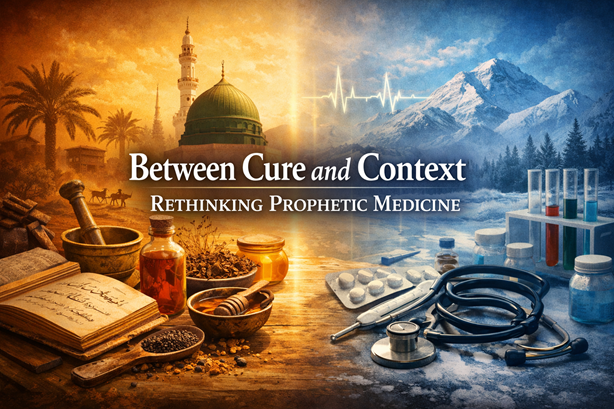
Between Cure and Context: Rethinking Prophetic Medicine

Waqar Akbar Cheema Abstract This paper revisits “prophetic medicine” (tibb al-nabawi) by addressing a central confusion in its interpretation: the conflation of truth with universal applicability. Hadith reports describing cures are often treated either as binding prescriptions or dismissed as context-bound and unreliable. Both readings, it is argued, are mistaken. Drawing on classical scholarship, the Read more

Between Cure and Context: Rethinking Prophetic Medicine Read More »

Hadith and the Impression of Substitutionary Atonement

Abstract Claims that Islam teaches substitutionary atonement based on the Abu Musa hadith collapse under close reading. By tracing the report’s three formulations, its placement in Sahih Muslim, and its explanation by al-Baihaqi, al-Nawawi, Ibn Ḥajar, and others, this article shows that the narrations describe reciprocal outcomes—not vicarious punishment. The explicit mention of Jews and

Hadith and the Impression of Substitutionary Atonement Read More »

Harm, Not Guilt: The Lizard and Ibrahim’s Fire in Hadith

Waqar Akbar Cheema Abstract Why was the house lizard/gecko mentioned in connection with the fire of Prophet Ibrahim (Abraham), and does the hadith imply punishment for an ancient act? This essay argues that it does not. By reading the reports together and in context, it becomes clear that the instruction to kill the gecko arose

Harm, Not Guilt: The Lizard and Ibrahim’s Fire in Hadith Read More »

displayed-size

Thanwi: Expressive Guidance on Delving into Qur’anic Eloquence

Maulana Ashraf ‘Ali Thanwi[1] Translated by Waqar Akbar Cheema On June 18, 1937, the Amritsar weekly Akhbar Ahle Hadith published an edict about a scholar from Azamgarh, UP, India, who had opined that the Qur’an contained some words that were not grammatically and rhetorically the best choice in their respective contexts but were nevertheless used

Thanwi: Expressive Guidance on Delving into Qur’anic Eloquence Read More »

Sab'a Ahruf

Sab‘a Ahruf Hadith: Sab‘a Indeed Means Seven

Waqar Akbar Cheema Abstract  One of the differences in the interpretation of ‘Sab‘a Ahruf’ hadith reports is whether sab‘a denotes the specific numeral or signifies an unqualified multitude. This paper analyses the phrase from a linguistic aspect besides exploring the details of the hadith reports bearing on this point. Opinions and proofs of certain past

Sab‘a Ahruf Hadith: Sab‘a Indeed Means Seven Read More »

Quran-Lost-Suckling-Verse-ICRAA.org_

Reality of ‘Missing’ Qur’anic Verse on Suckling

Waqar Akbar Cheema Abstract The article is about examining details of the saying of ‘Aisha of which a narration mentioned in Sahih Muslim has been used by critics to cast aspersions on the completeness of Qur’anic preservation in writing after the Prophet. Cross examining various narrations of ‘Aisha’s report on five-sucklings as proof required to

Reality of ‘Missing’ Qur’anic Verse on Suckling Read More »

Muhammad-Jauniyya

Truth about Jauniyya, the woman who sought refuge from the Prophet (ﷺ)

Waqar Akbar Cheema Abstract This article is about an academic inquiry into arguments around a Jauniyya woman’s mysterious and bizarre behaviour in the presence of the Prophet (ﷺ) in their first meeting after marriage. The interaction was brief yet odd and it culminated in immediate divorce. The nature of interaction made individual reports about it,

Truth about Jauniyya, the woman who sought refuge from the Prophet (ﷺ) Read More »

Two-Days-are-Equal-is-in-Loss-2-768x549

Hadith: “He whose two days are equal, is a loser”

Waqar Akbar Cheema … The title hadith is narrated in a number of ways. Here we shall discuss each of these ways separately. On the Authority of ‘Abdullah bin ‘Umar Qadi Abu Bakr al-Ansari Qadi al-Maristan (d. 535/1141) narrates: عن ابن عمر قال قال رسول الله صلى الله عليه وسلم: “من تساوى يوماه فهو مغبون

Hadith: “He whose two days are equal, is a loser” Read More »

Ijtihad

Misreading or Ijtihad: Origins of the Later Hanafi Opinion on Blasphemy

Waqar Akbar Cheema Abstract That Ibn ‘Âbidīn attributed the Later Hanafi Position that repentance of a person who blasphemes the Messenger of Allah (ﷺ) shall not be accepted in any case to a misreading by al-Bazzāzī has been picked up by modernists/liberals calling for the repeal of Pakistan’s contested Blasphemy Laws. This paper seeks to

Misreading or Ijtihad: Origins of the Later Hanafi Opinion on Blasphemy Read More »