Prophet

age-of-aisha-sm

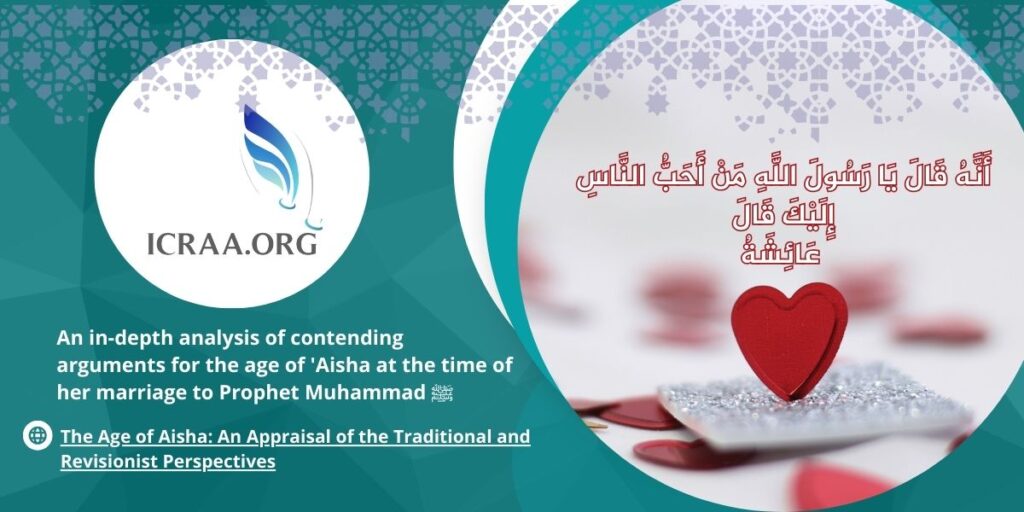
The Age of Aisha: An Appraisal of the Traditional and Revisionist Perspectives

Waqar Akbar Cheema Abstract This detailed paper delves into the question: how old was ‘Aisha (rA) when she married Prophet Muhammad (ﷺ)? It examines the arguments for the traditional opinion that ‘Aisha was nine years old at the time of consummation of marriage and the alternate-opinions arguments presented by scholars who question the authenticity of […]

The Age of Aisha: An Appraisal of the Traditional and Revisionist Perspectives Read More »

Ahruf Prophet Central

Seven Ahruf Scheme and the Centrality of the Prophetic Precedent

Waqar Akbar Cheema Abstract This paper shows how the Prophetic precedent comes out as pivotal to the sab‘a ahruf scheme. In highlighting aspects of hadith reports confirming this essential point, it is indicated how the grounding the validity of ahruf based recitations to the Prophet’s clear precedent goes with the reported rationale of ahruf. It

Seven Ahruf Scheme and the Centrality of the Prophetic Precedent Read More »

No-contagion-Hadith-1

On Meaning Of The Hadith “There Is No Contagious Disease”

Waqar Akbar Cheema According to a famous hadith in Sahih Bukhari, Prophet Muhammad (ﷺ) said: لا عدوى ولا طيرة، ولا هامة ولا صفر There is no infection, no evil omen, no hama, and no serpent in a hungry belly (safar). Problematizing the apparent meanings The above translation done by an orientalist James Robson is actually

On Meaning Of The Hadith “There Is No Contagious Disease” Read More »

Prophets-Mosque

Marriage Related Privileges of the Prophet: A Study in Chronology

 Waqar Akbar Cheema[divider]  Abstract The question about Prophet Muhammad’s (ﷺ) alleged inconsistency in taking more wives than allowed for Muslim men has generally been responded to by alluding to the Qur’anic verses that granted him certain marriage related privileges. The summary response, though correct, has faded some historical facts of Prophet’s (ﷺ) life bearing on

Marriage Related Privileges of the Prophet: A Study in Chronology Read More »

Muhammad-saaw

Prophet’s Marital Life: Unconsummated Marriages, Unmaterialized Proposals

Waqar Akbar Cheema[divider] The information below follows our earlier post mentioning basic facts about the marriages of the Prophet (ﷺ) in which we put together basic information about the wives of the Prophet (ﷺ) with whom his marriages were consummated along with mention of his concubines. In this piece we record the received information regarding

Prophet’s Marital Life: Unconsummated Marriages, Unmaterialized Proposals Read More »

Prophet-and-Abyad

Prophet Muhammad (ﷺ) and the devil named al-Abyad

Waqar Akbar Cheema Some people refer to certain quotes from Islamic exegetical literature mentioning a devil named al-Abyad. Firstly, it needs to be clarified that mention of a devil named al-Abyad is very rare in the Islamic literature of all genres. A contemporary scholar noted: Al-Abyad does not seem ever to have become a major

Prophet Muhammad (ﷺ) and the devil named al-Abyad Read More »

Egypt-Art-Maria-Copt

Maria, The Copt: Prophet Muhammad’s Wife Or Concubine?

Waqar Akbar Cheema Abstract Maria, the Copt, sent to Prophet Muhammad (ﷺ) by the Patriarch of Alexandria spent the rest of her life in Madina where she embraced Islam and lived with the Prophet () eventually bearing him a son. Though generally well-known in the Islamic tradition as a concubine of the Prophet (ﷺ) and

Maria, The Copt: Prophet Muhammad’s Wife Or Concubine? Read More »

Muhammad-Asad-1900-1992

Muhammad Asad on Aisha’s Marriage with the Prophet

Muhammad Asad Following is the reproduction of Muhammad Asad’s (1900-1992), treatment of the subject. Though short in length it is very comprehensive and touches upon all the aspects to the issue. Shortly after Khadijah’s death, about two and a half years before the Hijrah, the Prophet married ‘A’ishah, who was at the time between six

Muhammad Asad on Aisha’s Marriage with the Prophet Read More »

Ijtihad

Misreading or Ijtihad: Origins of the Later Hanafi Opinion on Blasphemy

Waqar Akbar Cheema Abstract That Ibn ‘Âbidīn attributed the Later Hanafi Position that repentance of a person who blasphemes the Messenger of Allah (ﷺ) shall not be accepted in any case to a misreading by al-Bazzāzī has been picked up by modernists/liberals calling for the repeal of Pakistan’s contested Blasphemy Laws. This paper seeks to

Misreading or Ijtihad: Origins of the Later Hanafi Opinion on Blasphemy Read More »